
Writing /
AI infrastructure
GPU fabrics for training and inference: RoCE and InfiniBand, congestion, sizing and reference designs.
Data center & enterprise networkingLow latency & tradingAutomation
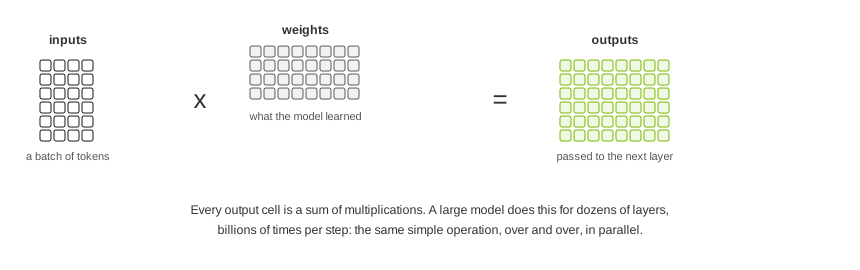
CPU, GPU and TPU: what each one does, and how they work together in an AI cluster
Why AI runs on GPUs and TPUs rather than CPUs, what is different inside each chip, their pros and cons, and how CPUs, accelerators, memory and the network cooperate in every training step.
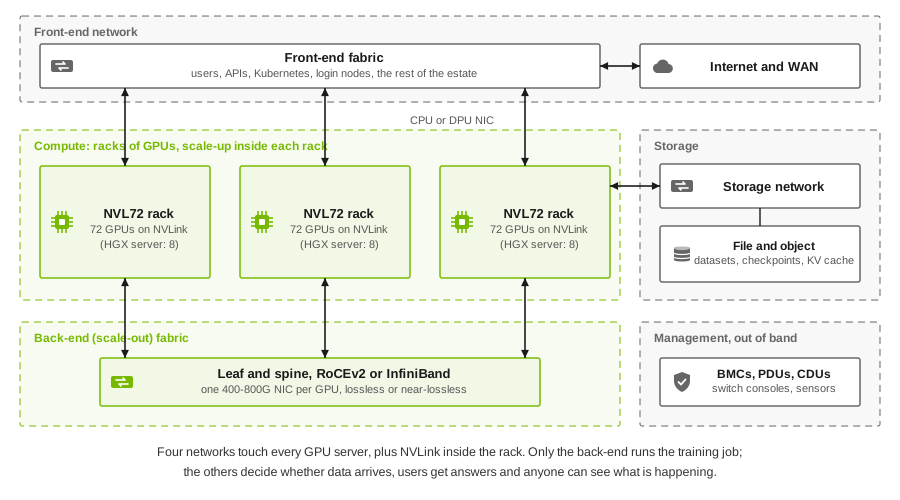
AI factories, from the grid to the GPU: size, networks, power, cooling and money
A network architect's tour of the AI factory in 2026: how big the sites really are, the five networks inside one, how training and inference differ, why power and cooling now set the design, what a gigawatt costs, and what is shipping versus what is still a roadmap.
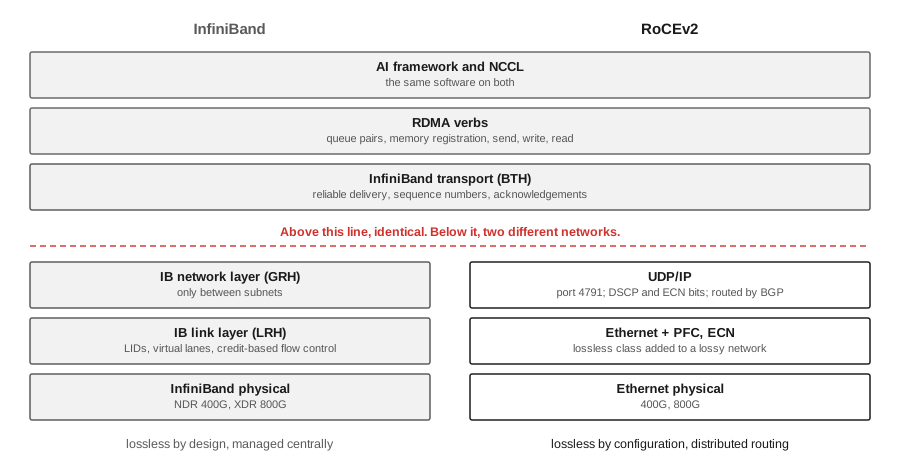
InfiniBand or RoCEv2 for an AI factory: how each works, and how to choose
Both carry the same RDMA transport; the network underneath is what differs. How InfiniBand and RoCEv2 each deliver lossless, low-latency fabrics, their real strengths and weaknesses for AI training, and the requirement cues that should decide between them.
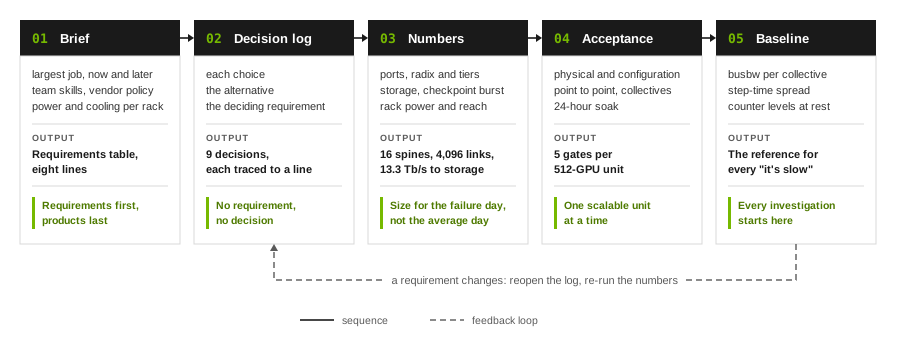
Reference design: a 2,048-GPU training cluster, from brief to acceptance
A complete back-end, storage and front-end design for a 2,048-GPU pre-training cluster that must double without a rebuild. Nine decisions, each traced to a requirement, and the five-stage acceptance plan.
Lossless RoCEv2, explained: ECN, DCQCN and PFC, from the packet to the counters
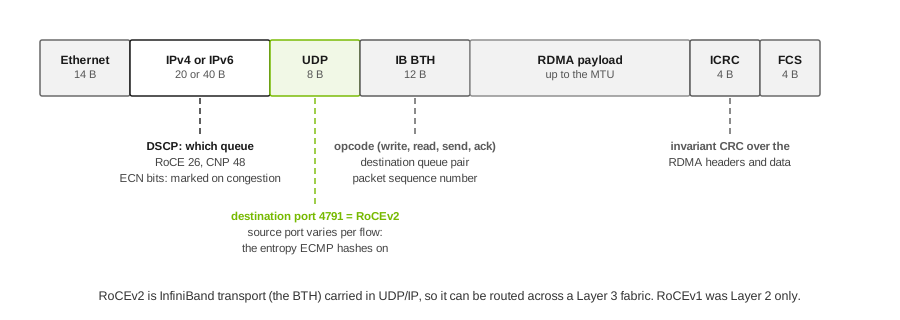
How RDMA runs on Ethernet without losing packets: what a RoCEv2 packet carries, how ECN, DCQCN and PFC work together, where the thresholds go, how much headroom a port needs, the side effects of PFC, and the counters that prove it works.
Coming soon
NVIDIA-Certified Professional: AI Networking
4 parts of the NCP-AIN study series published on this topic; the next part is out on 23 November.
- NCP-AIN Domain 1: AI workload traffic patterns, NCCL collectives and fabric design constraints
- NCP-AIN Domain 1: rail-optimized topologies and GPU-to-GPU paths
- NCP-AIN Spectrum domain: Spectrum-X architecture, and what the switch and the SuperNIC each do
- NCP-AIN Spectrum domain: RoCE on Spectrum-X, QoS, ECN and PFC end to end
CCDE Practical: AI Infrastructure
1 part of the CCDE AI study series published on this topic; the next part is out on 27 November.